home.health.love

A balanced and easy approach to healthy living.


1 Comment

Your Kid Likes Veggies?!?

Friends of ours often comment on my daughter’s penchant for veggies. She’s almost 23 months and has been enjoying veggies since she was six months old. She requests them for snacks and meals. At least half of what she eats in a given day consists of raw fruits, vegetables, and sprouted legumes. When she sees me eating a salad, she sticks her hand in the bowl, pulls out some leaves, and munches away.

I’m excited to share the strategies I’ve used for almost two years now to encourage my daughter’s interest in whole foods, particularly raw veggies and sprouts. I’ve learned that starting early and being consistent are key. Every child and family situation is different, and what works for ours may not work for another, but perhaps some of these strategies will work for your little ones:

1) Expose baby to veggies in utero and during infancy : I ate lots of veggies throughout my pregnancy (after morning sickness subsided, of course!) and while I was exclusively nursing her. I believe that exposing her in the womb and then through breast milk to various flavors  of fresh, whole foods, helped her develop taste buds that are keen on veggies, fruits, and legumes. If you don’t have boobs (i.e. dads and soon-to-be dads), encourage your partner’s healthy eating by making her veggie dishes and salads she will enjoy–the benefits will trickle down!

2)  Baby’s first foods should be veggies, then fruits: When it comes to first foods, start with veggies (and bananas are great, too). There is no rule that says that you need to start kids on cereal first. In fact, Dr Sears, and more and more pediatricians recommend avocados as the perfect first food. Why not let your infants start their exploration into food and flavors with the healthy, whole, from-the-ground stuff instead of the highly processed stuff? If I were constantly fed cereals, I probably wouldn’t develop much of a taste for veggies, either. Carbs are just too addictive.

My daughter’s first foods were avocado and banana. The great thing about these two foods is that they are not only nutritious, but are soft enough to be eaten raw (for full nutritional value) by an infant. After eating these for a month or so (while still nursing), we introduced her to other veggies, like cooked butternut squash, carrots, and peas. Then we went on to pea shoots, baby greens, lentils, quinoa, and some fruit.

Some people swear that kids should be exposed to veggies before fruits, because once they taste the sweet fruity stuff, they won’t want to go back. I agree for the most part, though I believe that bananas are an exception. They are an excellent first food for any baby. Bananas continue to be one of my daughter’s favorite foods and I am TOTALLY ok with that!

3) Eat the way you want your child to eat: Modeling is so crucial. Demonstrate the healthy eating habits that you want your child to acquire. When we have dinner as a family, there’s nearly always a raw salad on the table, plus cooked veggies or legumes. Your child will mimic your habits, good and bad, so try to make them good!

4) Lead with veggies: Whenever it’s time for a meal or a snack, I offer veggies first (assuming it’s convenient to do so). If you offer a sandwich, pasta, or other processed food first, they’ll definitely say yes to that, fill up, and you can forget the veggies!

5) Make it interesting and fun: Lately, to keep up her interest, I’ve been giving my daughter her veggies along with a healthy dip, like humus, guacamole, or salsa. She is really enjoying exploring different dips and loves sticking her cut veggies into the gooey stuff. If you prefer to cook, lightly saute your veggies in different sauces and flavors. Do you have other creative ideas? Share them in the comments section, please!

6) Encourage her savory tooth instead of her sweet tooth: Sweet foods tend to be worse for you and more addictive than savory foods, so I rather my kids enjoy the latter when they’re in the mood for a treat. The treats I keep in the house for my daughter (and for her parents 🙂 ) are chips. I’m not talking Frito-Lay. I buy the kind you find in a health food aisle: non-GMO, often organic, always baked (never fried), and usually made out of lentil flour, corn and/or a mix of whole grains. My favorite brands are Food Should Taste Good, R W Garcia, and Mediterranean Snacks.

7) Don’t proactively offer sweets…: Our culture associates special occasions with high-sugar and high-fat foods. I think I speak for the vast majority of people when I say that a birthday is not a birthday until some cake, cookies and other treats have been eaten. But no child is born with the belief that special occasions and treats must go together: this is a product of nurture, not nature! Your child doesn’t know that she’s meant to have cake or ice cream on her first birthday, so why go out of your way to encourage it? The need to eat unhealthy to celebrate is OUR need–i.e. the parents’ need–not the child’s need! So celebrate with some fruit, yogurt, or whole grain baked good, instead–your kid will not know any better. Better yet, just have a healthy meal, find a way to incorporate a candle, sing happy birthday, open presents, and call it a day. I actually baked a gluten-free carrot-chocolate cake for my daughter’s first birthday party that got rave reviews from guests. She didn’t even look at it, so I didn’t offer it to her, and she still had the best time.

8) …but don’t deprive your child–give them a treat when they ask for it: I don’t proactively offer sweets (per #7), but if my daughter asks for a treat–usually when we are at a social affair where we are surrounded by junk food and desserts–she often gets it. You’re shocked, right? Yes, most times my daughter asks for a food, I give it to her. Sometimes I’ll try to distract her from her request. But, if she insists, I give her what she wants. My only exceptions are candy and gummies (because they’re made of pure corn syrup), and dried fruit (because these stick to the teeth, and until she lets me help her brush her teeth, she ain’t getting any!).

Here is my reasoning: If you say no, your child will only desire it more (this is a universal truth). And, I’d prefer my child to explore foods under my watchful gaze, so I can impose limits, than let her get older and start exploring on her own. The good news: because I’ve followed the strategies listed here, half the time she doesn’t ask for treats when she sees them. And when she does, I offer her some, and she ends up eating just a small portion! So it’s a win-win.

9) Keep fruit juices and sugary drinks out of the house or hidden: It’s no secret that kids these days are addicted to sweet drinks, especially juices, that have a high sugar content. If you don’t keep juice, candy, or other sugary treats around, your child won’t be used to seeing them, and won’t start to believe that there is anything special about them. They won’t know to ask for them if they don’t see you consuming them! We have some cookies and ice cream, which we break out when she’s asleep 🙂

It’s been so gratifying to watch my daughter become a healthy eater. Granted, she’s still an only child and young enough that I still have control over her environment a  majority of the time. As she spends more and more time away from her parents and with her peers, I’m sure I’ll encounter new and different challenges around eating healthy. But, hopefully, by the that time, at least some of her good habits will have stuck 🙂

What are your own tips to encourage healthy eating?


Leave a comment

Coconut Oil: The Best All-Purpose Skin Care Product

First, I want to plug the home.health.love Facebook page. If you find this blog useful, then others you know may enjoy it, too. Please help spread the word by clicking on the Facebook “Like” button on the right-hand side of this page. Thank you!

Now onto coconut oil…

People love to cook with coconut oil. Experts say it’s the healthiest of all oils: it’s good for your heart, thyroid, immune system, and can actually support weight loss. It’s also great for cooking and baking because it can withstand high heat and doesn’t break down into potentially toxic components when cooked.  For a good discussion of all of these health benefits, check out Dr. Mercola’s article.

But it’s also a GREAT all-natural skin care product. You’ll love it! Here’s why:

Coconut oil is a great all-purpose skin AND hair moisturizer! It doesn’t clog your pores, or leave your skin feeling dry, as do some products containing water or alcohol. You can use it on your face, body, hands, and even instead of lip balm. You can also use it to deep condition your hair and tame frizz. And, it’s great for moisturizing soft baby skin!

It comes highly recommended as an all-natural personal lubricant (though not for use with latex).

It’s a great alternative to Vaseline for lubricating a thermometer when taking a baby’s rectal temperature. Vaseline is made from mineral oils, which are possibly carcinogenic.

Finally, it’s also a great healer. When I have a rash, skin irritation, itchiness, or burn (from sun, or from a skin product that’s a bit too harsh for my skin) anywhere on my body, I use coconut oil. It cures my skin ailments, and does it quickly. Try it and see if it works for you. At the very least, it should provide soothing comfort.

Coconut oil is a solid at room temperature (up to 76 degrees F.). I keep a little plastic spoon or knife right in the jar to help me scoop some out when I  need it. Once it touches your skin, it melts into a liquid and is easily spreadable. It’s a little greasy, but does absorb quickly. Give it some time to soak into your skin before putting on any fancy clothing (yes, I did that once, necessitating a last-minute wardrobe change, and I was very late to a fancy event!)

Other benefits:

  1. Only ONE ingredient: never worry about what artificial substances have been added. It’s like a breath of fresh air. I hate worrying about unknown substances in my skin-care and make-up regimen. Coconut oil is worry-free.
  2. Same product for the whole family: I keep a jar in my bathroom and by my daughter’s changing table. Sometimes I scoop out some of the coconut oil and put it in mini containers that I can keep in my bag, in my nightstand, or anywhere else I might use it.
  3. Has a barely-noticeable, but pleasant scent, which is good for those of us, like me, with sensitive noses.
  4. Easy to find: you can buy it at health food stores, online and supermarkets.
  5. Affordable: one jar goes a long way. You only need to use a little bit at a time. It lasts me months!

I buy the extra virgin, unrefined, organic kind, so I know it’s not made with GMO and is in its purest form. I’ve used Barlean’s and Spectrum Organics. I don’t have a particular brand preference, but I do like the fact that Spectrum comes in a glass jar. I’m always skeptical of plastic containers, so if I can easily avoid them, I do.

Please share your coconut success stories in the comments section!


Leave a comment

The Scoop on Arsenic in Rice

Though I’ve heard and read a bit about the discovery of worryingly high levels of  arsenic in rice, I’ve realized that many people are not aware of this news. So, let’s talk…I’ll discuss the health issues involved and make suggestions of what to do about them.

Let’s start with the background:

In 2012, the FDA and Consumer Reports conducted independent studies on rice and rice products sold in the U.S. and found that the levels of inorganic arsenic contained therein are quite high.

The concern about inorganic arsenic is that “long-term exposure can lead to the development of different types of cancer as well as serious cardiovascular, neurological, and other health problems.” (source, Science Daily). The International Agency for Research on Cancer (IARC) has classified arsenic as one of more than 100 substances that are Group 1 carcinogens. “It is known to cause bladder, lung, and skin cancer in humans, with the liver, kidney, and prostate now considered potential targets of arsenic-induced cancers.”  (source, Consumer Reports)

A while back, the EPA  set the arsenic standard for drinking water at 10 parts per billion; there is no such limit yet for food and drinks. According to Consumer Reports, the EPA had initially recommended half that amount, of 5 parts per billion, which is the standard enacted in NJ.

So using the 5ppb benchmark, Consumer Reports, testing samples from over 200 types of rice and rice products found that “a single serving of some rices could give an average adult almost one and a half times the inorganic arsenic he or she would get from a whole day’s consumption of water, about 1 liter.” (source, Consumer Reports)

And, why rice of all things? Because it absorbs arsenic from soil or water much more effectively than most plants, and most of the rice grown in the US is from the south-central region, which has a long history of producing cotton, a crop heavily treated with arsenical pesticides for decades. Arsenic also remains in animal feed, so there is danger of cross contamination.

The FDA is refusing to issue any warnings at this time. Here is a statement issued by a FDA Commissioner on the topic: “The FDA is committed to ensuring that we understand the extent to which substances such as arsenic are present in our foods, what risks they may pose, whether these risks can be minimized, and to sharing what we know. Our advice right now is that consumers should continue to eat a balanced diet that includes a wide variety of grains – not only for good nutrition but also to minimize any potential consequences from consuming any one particular food.” (source, FDA)

As usual, the FDA is slow to act on potential health hazards in our food. Unless there’s a clear bacterial outbreak caused by a food source, they typically drag their feet. For instance, when the National Resources Defense Council asked the FDA to issue a ban on BPA in products, it took the agency almost 4 years to respond (with a “no”). The point is that the fact that the FDA, despite its highly conservative nature, is even investigating the arsenic issue and continues to make it a “priority” to do so, says a lot already. Thus far, the FDA has tested over 200 samples, and claims to be testing 1,000 more.

You can see the results, in table format, of the Consumer Reports investigation (here) and the ongoing FDA investigation (here). If the number in the last column of either graph is above 5, then a single serving exceeds the New Jersey limit mentioned above.

What to do?

If you’re eating only a few servings of rice products a week, then you’re within the standard range for safe drinking water. You’re probably ok, though you should be aware that many food products may contain some rice in them.

But, three populations in particular, should be taking heed: pregnant women, moms of small children, and those eating a gluten-free diet. These individuals, myself including, may be ingesting several servings (or more) of rice per day, putting us way above the safe drinking limit concerning arsenic.

Here are practical steps to take, based on the research, my explorations, and recommendations by the food safety director at the Center For Science In the Public Interest (which I found in this helpful article):

  • Avoid baby rice cereals or limit to one serving per day, which is what Consumer Reports recommends. Consider another type of cereal. Better yet, why make cereal a base for your babies diet to begin with? Other easy-to-eat first foods are far more nutritious and are no highly processed: avocados, bananas, sweet potatoes, squash, etc. Even Dr. Sears recommends avocados as the ideal 1st food. My daughter is doing fine without every having eaten cereal, and last we checked, her iron levels were normal, too. Also, be wary of cereals that use rice syrup, since that has arsenic, too. Nature’s One, maker of organic baby cereals, has recently re-worked their organic dairy-based formula to exclude brown rice syrup and they’re doing the same with the soy version (source, scroll down to bottom)
  • Though brown rice is healthier, be aware that white rice tends to have less arsenic than brown or wild (which makes sense, because white rice has the outer layers removed). I’m not quite advocating switching over to white, though…
  • Wash and cook rice in lots of water! Wash rice in water, pre-soak it in water, use extra water when cooking (Consumer Reports recommends 6 cups water per one cup rice), and spill water out at the end. Unfortunately, this process also washes out some of the nutrients from the rice. Apparently this reduces about 30% of the arsenic.
  • Origin matters; Organic does not. Rice grown in CA has less arsenic. Even better, buy imported jasmine and basmati rice as these tend to have the lowest levels. Consumer reports lists the origins of the rice samples it tested, you can use this as a guide when purchasing rice. Otherwise, read labels carefully.
  • Eat less rice and rice products. Check out this nifty table from Consumer Reports which gives you recommendations of how many servings of rice products it’s ok to eat in one week  (based on the 5ppb limit). If you want to use the FDA’s 10ppb limit, then simply double the recommended number of servings. I easily exceed the weekly limits suggested here in a single day! Read the fine print above, as the table assumes you are only eating one of the products for an entire week, which is highly unlikely. (source)
  • If you’re gluten-free: think outside the box! If, like me, you enjoy and rely on rice-baked products to round out your diet, then eating less rice will be quite a challenge. It is for me. I enjoy pasta, waffles, wraps, breads, cereals, cookies, crackers, rice cakes…all made from rice. I use rice vinegar when I cook and make salad dressing. If I bake, my go-to flour mix includes rice flour. It’s hard to find gluten-free products such as these not made out of rice. Products that use buckwheat, quinoa or corn, say, in pasta, waffles and bread, often contain rice flour as one of the main ingredients.

Here are some non-rice GF alternatives I’ve discovered (all are certified kosher):

  1. Breakfast: For cold cereal, there are many none-rice alternatives, including corn flakes and other corn-based cereals. I love Udi’s Gluten-free GranolaHot cereal: Bob’s Red Mill Gluten-Free Steal Cut Oats. You can also use corn grits (polenta) to make a hot cereal, or cut them into squares and serve with butter and honey, yum. I haven’t found any GF waffles without rice. But, you can make your own waffles and pancakes using buckwheat flour, found in most healthfood stores.
  2. Lunch: I have yet to find a packaged GF bread that doesn’t contain rice, but you can make your own, there are lot’s of recipes out there like this one or this one. If you’re into wraps, La Tortilla Factory’s GF wraps are teff-and millet-based. I order them from Fresh direct.
  3. Dinner: Quinoa is an obvious choice, and switch up the colors–white, red, black–to get a variety of flavors. Polenta, which you can buy ready-made in supermarkets or in corn-grit form, is another alternative. You can dress it up with all sorts of flavors and I like to make polenta pizzas as a treat. And don’t forget, you can make buckwheat. In terms of pasta, very few GF varieties have no rice (even when they say they’re made with corn, buckwheat or quinoa), but Eden Organics has a 100% buckwheat soba noodle.

These are just a few suggestions of how to alter your diet to ingest less arsenic. I’d love to hear your ideas about how to minimize rice intake and any non-rice GF products that you enjoy!


3 Comments

Almond-Butter & Almond-Pulp Recipes

Almond-coconut macaroons

Almond-coconut macaroons

There are so many uses for almonds! I previously posted about how to make almond milk. If you follow the proportions I suggested, you’ll end up with nearly 3 cups of almond pulp. Waste not, want not: there are many great things you can make with the pulp! I’ve found that almond pulp lasts about 3-5 days in my fridge. So, if you don’t expect to use your pulp soon, just freeze it for later use. I’ve done this many times before and it works great!

Before I get into some ideas of what to do with your almond pulp, I wanted to briefly discuss making your own almond butter. Almond butter is a staple in my house. We just love it on waffles or toast with a sprinkle of honey or sliced bananas on top for breakfast. It’s also great in a sandwich with jelly. You can use it as a substitute for peanut butter in recipes.

Why eat almond butter instead of peanut butter? Well, apparently, almond butter has 25% less saturated fat, plus 26% more Vitamin E, 3% more Iron, and 7% more Calcium than peanut butter. It’s higher in magnesium, phosphorus, potassium and antioxidants (source; please note: I have not fact-checked this myself). Also, almonds are alkaline and peanuts are acidic. (Balancing your body’s ph with alkaline foods is supposed to promote overall health. This will be the topic of a future blog post!)

Here’s the super-easy “non-recipe” for almond butter: place one or two cups of unsoaked almonds (preferably raw and organic) in a food processor with the S blade. Process, scraping the sides down frequently. This could take about 10 minutes or more, but you’ll soon witness your almonds going from a flour-like consistency to a smooth spread. Add sea salt to taste. Store in the fridge. Apparently it can last for a few months. Yum!

Now, for the long-awaited almond pulp recipes!

I haven’t found and tried too many almond-pulp recipes. There are many baked goods that you can make with almond flour, which is NOT the same as almond pulp. But, you can make almond flour out of your pulp if you wish. I’ll tell you how, below, and give you some easy and tasty ideas of what to do with the pulp.

Almond flour recipe: if you have a dehydrator, then place the almond pulp on a teflon-lined tray and dehydrate at 115 degrees for 4-8 hours. Most of my readers probably don’t have a dehydrator. Instead, you can use your oven: set it to the lowest temperature possible, line a baking tray with parchment paper, and spread out the pulp. You will need to let it “bake” for about 3 hours. If you don’t have little ones running around, keep the oven door slightly open to let the air circulate better. Once the pulp is completely dried out, put it in your food processor to make it into a fine flour and store in your freezer. Use as needed. You’ll find tons of almond-flour recipes online.

Almond-coconut macaroons: I adapted this Martha Stewart recipe. The macaroons I made were more like almond-coconut balls, probably because the original recipe uses crushed almonds, which are dry, whereas almond pulp is a bit damp.

Ingredients:

2.5- 3 cups of almond pulp (i.e. yield from my almond milk recipe)
2 cups unsweetened shredded coconut
1/2 cup coconut nectar, agave, or maple syrup
6 egg whites
2 tsp. vanilla

Preparation:

  1. Preheat oven to 350 degrees. Line two baking sheets with parchment paper.
  2. Whisk together eggs and sweetener. Stir in remaining ingredients.
  3. Form into mounds. I use a measuring spoon (1 tbs size) to capture a heaping scoop of the dough, then rolled it into a ball, and placed it on the parchment paper. Keep the balls 2 inches apart.
  4. Bake until macaroons are slightly browned around the edges, about 15 minutes. Let cool.

Variations:

  • Lemony-coconut macaroons: Add 2 tbs lemon zest into the mixture,
  • Chocolate surprise: Stick a chocolate chip into the middle of each ball.
  • Chocoholics anonymous: Drizzle finished product with melted chocolate. You can refrigerate so the chocolate sauce hardens.

Zucchini-Almond Hummus: A found a recipe for this on a blog I like to read. I adjusted it slightly.

Ingredients:

2 cups almond pulp
2-3 large zucchini, chopped
1 clove garlic
3 tsps cumin powder
1 tsp salt  or to taste
Black pepper to taste
Juice of 1 large lemon
Fresh herbs (parsley, dill, cilantro, etc.; whatever you have on hand)
Water

Preparation:

  1. Place all ingredients into high-speed blender. Use tamp to push down the mixture so it blends well. 
  2. If mixture is too thick for blending, add water or vegetable broth, tablespoon by tablespoon, until ingredients blend well.
  3. Blend well and adjust seasonings and herbs to taste.

Banana-Chocolate Freezer Fudge: I have not yet tried this recipe, but it looks too good to pass up. Once I try it out, I will update the post.

Please, feel free to offer an feedback/tweaks to the recipes provided here, or suggest new ones, in the comments section.


Leave a comment

The Dish on Decaf

Because I spend a lot of time in coffee shops working on my dissertation, I get to watch a lot of moms and soon-to-be-moms drop in for their morning dose of Joe, sometimes with kids in toe. I notice that many of them tend to order decaf, and for good reason: caffeine has a questionable impact on fetal health, and caffeine in breast milk can make for an irritable baby. (UPDATE: I received my PhD in May 2014!)

But there is one thing to keep in mind when choosing where you buy your decaf coffee: the caffeine extraction method used.

There are several methods of caffeine extraction. Some use chemicals known as decaffeination solvents, such as methylene chloride or ethyl acetate. Methylene chloride used to be found in hairsprays and cosmetics until it was was banned by the FDA after it was found to be carcinogenic, but it’s still used to make decaf coffee. Ethyl acetate is another carcinogenic substance, used in nail polish remover and to kill insects. Because it’s found in small amounts in fruit, some coffee companies using ethyl acetate claim that they are using a “natural” extraction method, however it is far from that. (More scientific analysis on the possible health effects of exposure to MC can be found here and here; on EA, look here and here).

Safer methods of extraction include one that is completely water-based (sometimes called the “Swiss water method”), another that uses water along with a carbon filter, and one that uses water along with carbon dioxide. More info on all of these methods can be found here.

Naturally, it’s probably best to avoid decaf coffees that have been processed with chemical solvents and to opt for coffee using the Swiss water (preferable), carbon filtration or carbon-dioxide methods. But, you may have to do your research to find out which extraction method is used to make your favorite coffee.

If you like to buy already-brewed coffee from a shop or stand, ask a barista how the caffeine was removed. Chances are, they won’t know and you’ll have to ask to speak to a supervisor, who may or may not be equally unhelpful. If you like to get your coffee at one of the big chain coffee shops, then it’s best to call their customer service number and ask. Here’s the result of the research I’ve done on some of the national brands. (NOTE: THE INFO BELOW IS CURRENT AS OF MARCH, 2015):

SAFE BREWED COFFEE: Starbucks uses the carbon dioxide extraction method (source: web site). Wholefoods’ Allegro brand coffee uses the carbon filter method (source: web site).

BRANDS TO AVOID: Dunkin’ Donuts and Coffee Bean use methylene chloride (source: DD customer service line; CB web site, here).

If you like to brew your coffee at home, then you will have to dig around to learn how the caffeine was extracted from the coffee beans. Most manufacturers will not advertise the extraction method on the package–of course, this probably means that they use chemical solvents. You will have to call their customer service line to find out for sure. A good rule of thumb for packaged decaf coffee is this: the brands that use one of the safer methods are usually organic and often advertise their extraction method right on the package. Examples of such brands, for whole beans, include Allegro (found at Wholefoods), Jeremiah’s Pick and Seattle’s Best Organic (both use the water-based method). The only organic brand of instant cofee on the market, Mount Hagen, also uses the carbon dioxide process.

So, to sum up: if you are pregnant, nursing, or otherwise concerned with ingesting potentially harmful chemicals along with your decaf coffee, do your research to find out how the caffeine was extracted. You should assume that potentially-toxic chemical solvents were used, unless proven otherwise. Starbucks and organic decaf coffees are typically safe options.


Leave a comment

Quick and Easy Winter Soups

Carrot and celery root soup

Carrot and celery root soup

Soups are one of the most nourishing foods during winter time. You can make them in 30 minutes or less, with just about 10 minutes of hands-on time. They are also the most forgiving type of food you can make: you can overcook them, and it’s no big deal; you don’t need to cut up all the ingredients in perfectly-sized portions; and, bottom line, unless you over-salt, it’s hard to go wrong. Plus, they refrigerate well, so one batch will last a few days or more. Added bonus: thicker soups work well as baby food!

If you have a few soups you can make in under 30 minutes, then you are good for the whole winter.

I wasn’t into making soups until I attended a cooking demo by a healthy-food chef and realized how easy they were to make. Until then I had been intimated by the whole process. So, what I hope to do is to de-mistify soup-making for you. I also want to give you some ideas for ingredients, and most of all: provide you with a “template” for making all sorts of creamy, vegetarian soups. I say “template” and not “recipe,” because a template gives you lots of flexibility and encourages you to experiment. With the template, below, you can vary the ingredients, but the steps are more or less the same! This means that you no longer have to spend time searching and following recipes. Once you get the hang of using this template, the whole process will become second nature to you.

NOTE: A major time-saver for making soups is using store-bought stock. Making your own is great, but it takes a while and needs to be done ahead of time. I’d never make soups if I had to make my own stock every time. Instead, I use Pacific’s organic, low-sodium vegetable stock. It comes in 1-quart cartons, and I keep at least 3 in my pantry at all times. I prefer Pacific over other brands because every single ingredient in the Pacific stock is either water, a vegetable, herb, or sea salt. Other brands have additives in them. Pacific broth is available in most supermarkets.

Quick and Easy Winter Soup Template

Equipment:

Pot (6 quarts or more)

Immersion blender (I have something similar to this)

Ingredients:

Olive oil

Aromatics (onion, leek, and/or garlic; chopped)

Vegetable # 1 (one root, squash, or cruciferous vegetable; chopped)

Vegetable # 2 (another root, squash or cruciferous vegetable; chopped) (optional)

Leafy Green (kale, spinach, collards, chard, etc.; chopped) OR fresh herb (parsley, dill, etc.; minced) (optional)

Salt and pepper (along with other optional spices: cumin, coriander, turmeric, etc.)

Vegetable stock (4-6 cups home-made or one box store-bought plus water)

Preparation:

  1. Sauté aromatic (onion or leek) in a few tablespoons of olive oil for 5 minutes on medium heat. If adding garlic (I usually do, because of it’s immune-boosting properties), then add it when you have 2-3 minutes left of sautéing.
  2. If using flavorful spices other than salt and pepper, add them while sautéing oinions. Think: cumin, coriander, turmeric, paprika, a dash of cayenne, etc.
  3. Add Vegetable # 1 and Vegetable 2, if using second vegetable.
  4. Add 1 quart of vegetable stock (one store-bought container) to cover vegetables. If there is not enough stock to cover vegetables, then add additional stock or water. (I often add water so I don’t have to open another container of broth).
  5. Bring soup to boil, then reduce heat to low and simmer for 20-30 minutes, or until vegetables are soft enough to purée.
  6. If adding leafy green or fresh herb, add to top of pot at the end of cooking time, and let it steam for a a few minutes on top of other vegetables. Do not mix in. This way, you are not over-cooking it and destroying valuable nutrients. It will turn a bright green color when ready.
  7. Use immersion blender to purée soup. Add salt and pepper, and adjust other spices, to taste. Add stock for desired consistency.

NOTE: if making baby food, you should err on the side of less stock so it’s not too thin. You can use one pot to make both baby food and soup. Simply, make soup using less stock and purée until you reach desired baby-food consistency. Then, remove a portion enough for baby. Finally, add more stock to put and purée until desired consistency has been achieved for rest of family.

Ideas for Soup Ingredients

Below are some ideas for soup ingredients that you can use with the above template. This is my personal repertoire of soups: easy-to-find ingredients, tasty, and affordable in the organic versions. You can follow my suggestions, or use them as inspiration for your own recipes.

For a nicely formatted pdf of the table below, click here: Soup Ingredients

Aromatic
(I add garlic to everything)
Veggie #1 Veggie #2 Leafy Green or Fresh Herb Spices/ other (use salt and pepper for all)
Leek
(2-3 stalks)
Potato
(approx. 2 lbs)
Parsley and/or chives
Leek
(2-3 stalks)
Cauliflower
(1 large head)
Parsley and/or chives
Onion
(1 large)
Cauliflower
(1 large head)
Kale, chard, or spinach (I bunch or a few handfuls) dry white wine (I cup) (optional)
Onion
(1 large)
Butternut Squash (approx. 3 lbs.) 1-2 tart apples (optional)
Onion (optional) Carrot
(approx. 2 lbs)
Celery Root
(1 large root)
Cumin, coriander OR few tbs’s sherry
Onion (optional) Carrot
(approx. 2 lbs)
Ginger
(2 tsps. or to taste)
Onion Carrot
(approx. 1 lb)
Yam
(approx. 1 lb)
Cumin, coriander

I’d love to hear about your favorite, go-to soup recipes; please share in the comments!


2 Comments

Cold and Flu Prevention and Treatment: Natural and D.I.Y

In my home, viruses and bugs like to play musical chairs with our immune systems. First my daughter gets sick, then me, then my husband, and then the cycle starts all over again. A couple of months ago I was perpetually sick for more than 4 weeks. I finally had enough of it! I committed to being consistent about my cold-prevention regimen, and so far, so good.

One of the amazing things about natural remedies, is that you can use them to both prevent AND treat. Often, you just need to increase the dose and frequency of the remedies when you are actually sick. Here is what I do, below. I offer DIY alternatives, when possible. You can do all of these together, or mix and match.

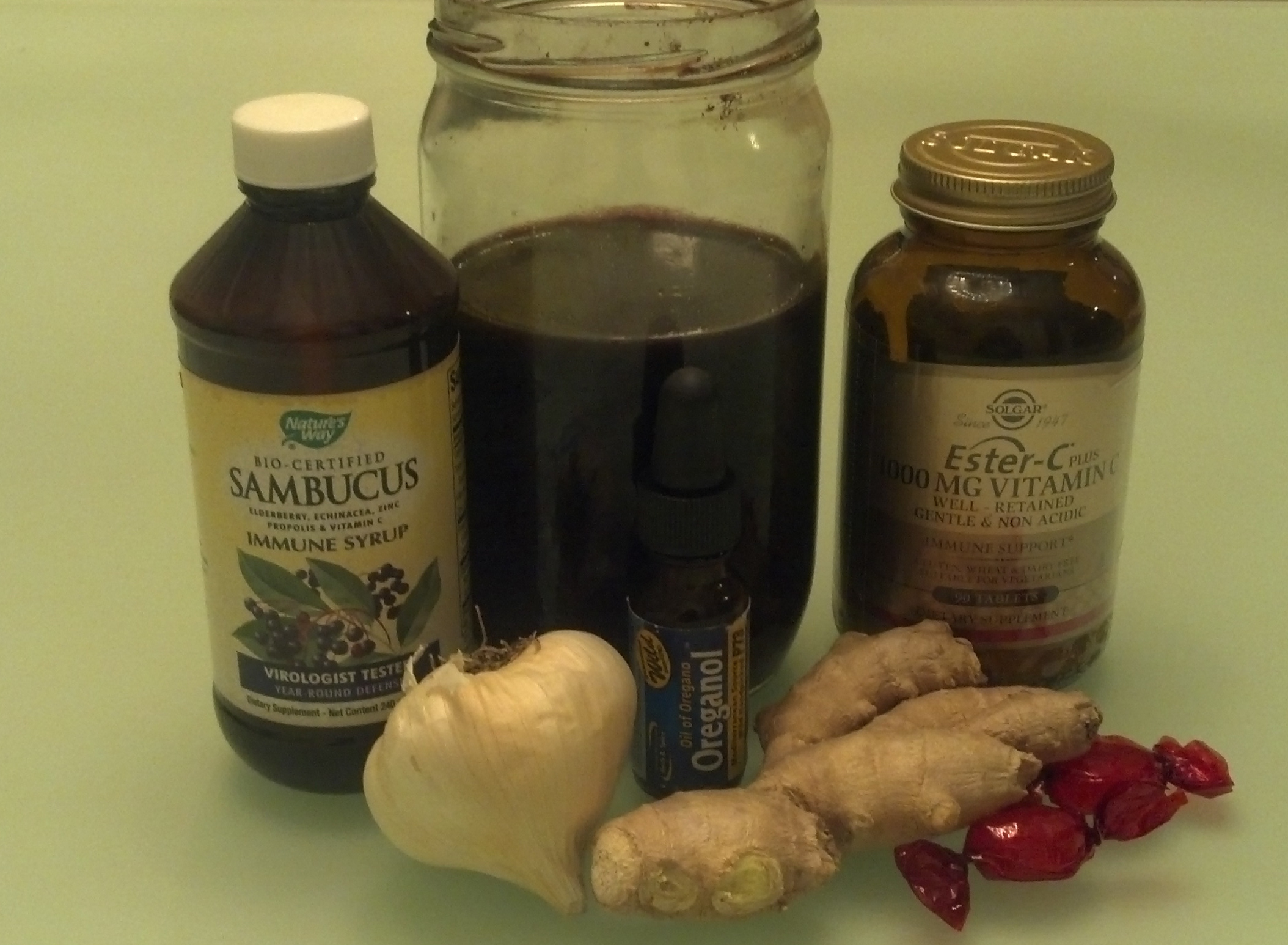
Elderberry syrup (store-bought and homemade); garlic, ginger, Vitamin C and zinc losenges

Elderberry syrup (store-bought and homemade), garlic, ginger, vitamin C and zinc lozenges

1. Daily multi-vitamin and C: When I’m feeling good, getting sleep, and people around me aren’t coughing and sneezing, I don’t take a multi-vitamin every day. I eat pretty well, and it’s best to get your nutrients from real food. But during flu season, I take my multi every day, just in case, and I add additional C. If someone in the house is sick, I’ll take a C vitamin several times during the day. Make sure to consult your health practitioner about the right C-vitamin dosage for you.

2.Eat lots of garlic and ginger: both are immune-boosting, anti-inflammatory agents. Use them as often as you can in your cooking. They are great in stir-fries, soups, and you can make great sauces and marinades with them. Try to under-cook them a little bit so they have maximum nutritional value, if you can handle the flavor. I enjoy making a ginger-teriyaki sauce for salmon and veggies: combine soy sauce, minced garlic and ginger, honey and orange juice (optional). People always ask me for the recipe.

Here are some AWESOME TIME SAVERS to make cooking with garlic and ginger EASY and QUICK:

  • You can buy whole, peeled, organic garlic in health food stores. This way, it’s ready to go.
  • GINGER DOES NOT NEED TO BE PEELED! Did you know that? Buy organic, wash it, and then mince it with the skin. I do this all the time, and nobody notices it wasn’t peeled.
  • At the beginning of the week, mince garlic and ginger (separately) in a mini-food processor or blender, and then store them in separate containers in your fridge. This way, you can just grab a pinch (or a handful!) and throw it into whatever dish you are cooking! They will keep for about 3-7 days in the fridg.

3. Elderberry (Sambucus): relieves coughs and congestion, enhances immune function, lowers fever, soothes the respiratory tract and is effective against flu viruses. Awesome, right??? It’s typically found in syrup form in health food stores and online in a bunch of varieties for adults and children. It tastes good: like berry-flavored maple syrup.  My favorite is Nature’s Way “Immune System Syrup,” which includes also includes echinacea, propolis, zinc, and vitamin C. The directions instruct you to take a certain amount for daily consumption to prevent illness, and an increased amount for when you are sick. Note: if you are pregnant, elderberry is not recommended, though it’s generally ok for nursing mothers and infants and toddlers (read more here). As always, consult your doctor.

But, I promised you DIY, right? And the syrups can get a little pricey (about $10-$20 for 8 oz). So here’s how you can make it yourself: To start, buy organic, dried elderberries. For about $20 (or $14 for the non-organic version) you can make yourself a bunch of bottles of the syrup, probably enough to last you a few months or the whole season!  I found and used a recipe from one of my favorite natural-living blogs: the Soft Landing. I omitted the clove powder from the recipe, otherwise all the other ingredients were already in my kitchen! The glass jar in the photo, above, contains my home-made version!

4. Oregano oil: Some people refer to oregano oil as “nature’s antibiotic.” It’s made from varieties of the plant found in the Mediterranean region, not the kind you find in stores. Numerous studies have been done illustrating its antiseptic and healing properties (see summaries here). It has a strong taste, but you only need a few drops at a time. And, it seems expensive, but it’ll take you many months to go through it, since it’s so potent. I usually buy the Oregonal brand–you’ll be convinced by the amazing reviews on Amazon!

5. Zinc: Another immune-system booster, in lozenge or supplement form. Follow directions on the label. Zinc supplements should only be taken when treating a cold. Do not exceed 100mg. Consult your doctor.

Happy Preventing and Happy Treating! I’d love to hear about your favorite cold remedies in the comments section!


Leave a comment

How to enjoy your sprouts!

This post is a follow-up to my recent post, “The Miracle of Sprouting,” where I discussed how sprouting works, the amazing nutritional benefits of sprouting, and six easy steps to making your own sprouts–quickly and cheaply!

(Here’s one more nutritional fact, I couldn’t help myself 😉 : 1 oz. of broccoli sprouts have the same amount of antioxidants as 3 lbs. of broccoli! source).

In this post, I will share some ideas of how you can enjoy your sprouts. At the end, I’ll tell you where you can buy seeds for all sorts of wonderful sprouts!

2013-02-01 14.07.55

  1. Pop-’em: eat them plain, as a snack. The bean sprouts–especially mung bean and chickpea–are crunchy, so kids will enjoy them, too. My daughter happily eats sprouts for any meal, including breakfast! She pops them in her mouth like candy. She enjoys them so much, I’ve started to hide my sprout jars because when she sees them on my counter, she demands to have some, even when they are not ready. Tell your kids they are like “nuts” or baby “puffs!” They won’t know that what they’re eating is essentially a multi-vitamin!
  2. Sprinkle them on top of a green salad for a crunchy, nutty addition.
  3. Make a sprout salad using one or more varieties with some salad dressing. This can be eaten as a salad course or a side dish.
  4. Use them as an ingredient in a sandwich or a burrito wrap, vegetarian or not. I especially enjoy them in a sandwich that also includes avocado, pepper, and/or carrot ribbons.
  5. Add them to your stir-fry, either while cooking, or just before serving, as a garnish. I recommend doing the latter, since cooking reduces the nutritional content of live foods. But, hey, that’s how some of you will enjoy eating them! If you prefer cooking them, I recommend adding them a minute or two before the stir-fry is done, so that they have the least exposure to high heat.
  6. Make sushi or spring rolls! I got this idea from Jennifer Cornbleet’s book, Raw Food Made Easy (a book my mom bought me  when I barely new anything about raw-fooding!). There’s no real recipe for this, except that sushi requires nori sheets and spring rolls require a leaf to wrap up the ingredients (think: romaine, cabbage, green leaf, etc.). Along with your sprouts, you can add sliced avocado, sweet pepper, cucumber, carrot (grated or in ribbons), herbs (cilantro works great), scallions, and anything else you like. Layer your ingredients along the short end of the nori sheet, and roll toward the opposite end. Add a dressing or sauce–like teriyaki, soy/tamari, peanut, miso, carrot ginger, or anything else you enjoy–in the nori roll, or on the side for dipping. Don’t bother cutting the roll into pieces, because ingredients will fall out. Eat it like a hand roll. A few rolls make a tasty raw lunch!
    Ingredients placed on nori sheet, on short side.

    Ingredients placed on nori sheet, on short side.

    Rollin' it up!

    Rollin’ it up!

  7. Make a pate or chumus out of your sprouts! Making a paté out of your spouts (or chumus, if it’s chickpeas), involves putting a few basic ingredients into your food processor, along with your sprouts: minced onion or garlic (or both), lemon juice, herbs of your choosing (cilantro and/or parsley are great choices), salt, seasoning (cumin is great for this, but also paprika, turmeric, cayenne pepper, curry etc.) and some olive oil. If you’re making chumus, then replace the olive oil with tahini. For exta flavor, you can also add in some say sauce/tamari/nama shoyu (all variations of the same thing). Experiment with different proportions and different herbs and spices! Make it your own! You really can’t go wrong, since you can always adjust the taste if it’s not quite right. If you’re not feeling quite daring just yet, here are recipes from the web to inspire you: Jennifer Cornbleet’s paté (sub in any legume for the walnuts) or Vegan Baker’s Raw Sprouted Chumus.

I’d love to hear if you’ve used these ideas or if you have any new ones to add!

Before I sign off: For those of you looking to expand your sprouting repertoire, the best site out there is sproutpeople.org. They sell  seeds for leafy sprouts (clover, alfalfa), bean sprouts,  broccoli and brassilica sprouts, exotic sprouts, and sprouting nuts and grains. For each type of sprout, they have specific instructions and some how-to videos. They also have sprout mixes that taste really great. And, finally, they have lots of “equipment” like sprouting jars and lids, as well as all sorts of sprouting devices.

Mesh screen lids for sprouting jars, made by Sproutpeople. Image courtesy of Sproutpeople.

Sproutpeople’s French mix (their most popular one): Clover, Arugula, Cress, Radish, Fenugreek, Dill. Image courtesy of Sproutpeople.

Enjoy!


3 Comments

The Miracle of Sprouting

Warning: this post may blow your mind.

What if I told you that YOU can grow some of the most nutritious foods quickly and easily right in your own kitchen? Foods that researchers have found to contain incredible disease-fighting properties, as well as very high levels of protein, antioxidants, vitamins, and phytochemicals. In other words, foods that carry more health benefits that most of the vegetables you have in your fridge right now.

Now, sit down, because it gets even better.

What if I told you that all you needed to accomplish this amazing feat was a glass jar, water, and a piece of cloth? And, that all it would take is a few minutes a day?

You’d think I was crazy, right? But, I’m not, and this is for real.

I’m talking about sprouting. Sprouting is one of the easiest ways you can dramatically boost your family’s nutritional intake. And you can do it yourself–cheaply and easily.

Let me first tell you about the health benefits of sprouting. Then I’ll tell you how to do it. And, finally, I’ll end with some ideas about how to consume your favorite sprouts.

Health Benefits:

Sprouts are one of the richest source of vitamins, minerals, and anti-oxidants of all fresh food.[1]

Why are sprouts so nutritionally dense? Because, during germination the nutrients stored in the seed are released to fuel the growth of a full-grown plant (remember high school biology class?). Once germination begins, complex biochemical changes take place in the seed. Enzymes are produced to break down proteins, starches, and fats into simple compounds. These simple compounds are then used to make new compounds.[2]

The wonderful results? Sprouting increases the vitamin value and anti-oxidant content of the seed[3]  by as much as 20 times! [4] And, it’s not just the vitamin content that’s increased. For instance, one study demonstrated that broccoli sprouts contain special cancer and other disease-fighting agents that are lacking in full-grown broccoli.[5] Another study found that sprouts such as alfalfa, clover, soybean, and flaxseed play an important role in the prevention of menopausal symptoms, osteoporosis, cancer and heart disease.[6]

I could go on for days, but need I say more?

How to sprout:

You can sprout almost any bean, seed or grain.  Most of these are very easy to sprout, though the technique does vary from seed to seed.

From my experience, the easiest things to sprout are beans, such as mung beans, lentils, and chickpeas. These beans are easy to find in health food stores and even super markets. Their sprouts are also tasty, crunchy and fun to eat for adults and kids. If it’s your first time, I recommend starting with mung beans, which you can find packaged or in the bulk aisle of most health food stores, including Whole Foods.

Equipment:

Glass jar, quart size (e.g., pasta sauce or mayonnaise jar; if you’re fancy, you can purchase a mason jar)

A square of cheesecloth, mesh screening, coarse kitchen towel, or sprouting jar lid (I use, and re-use, cheesecloth)

Ingredients:

Mung beans, lentils, or chickpeas

Water

Preparation:

  1. Fill jar about an inch high with beans (they will expand). Fill jar with water until a few inches from top. Loosely cover jar with piece of cheesecloth, screen or towel. Let sit overnight or for 8-12 hours.
  2. Drain water and rinse beans a couple of times with fresh water. Then pour out all of the water. Beans will remain damp.

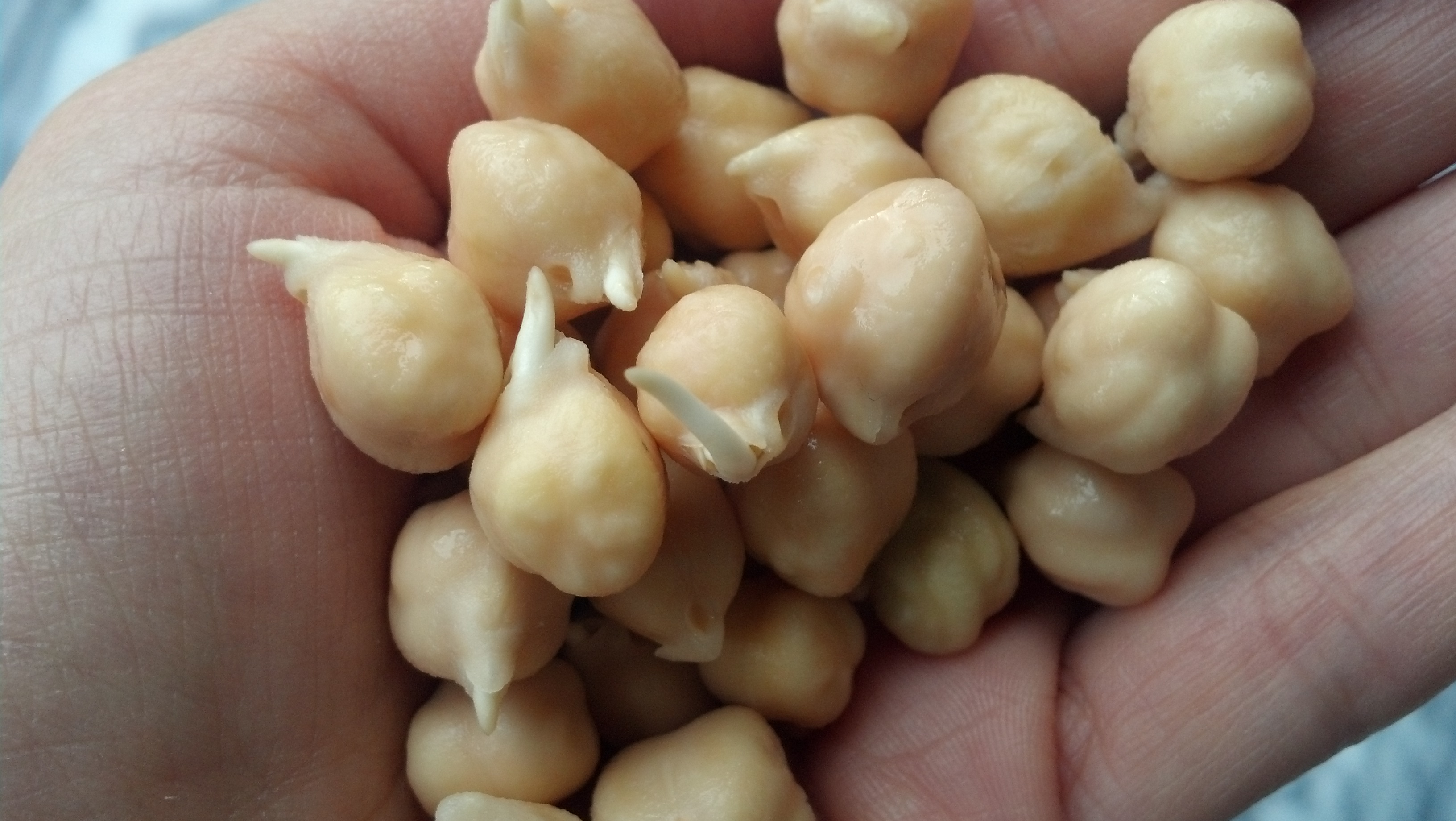
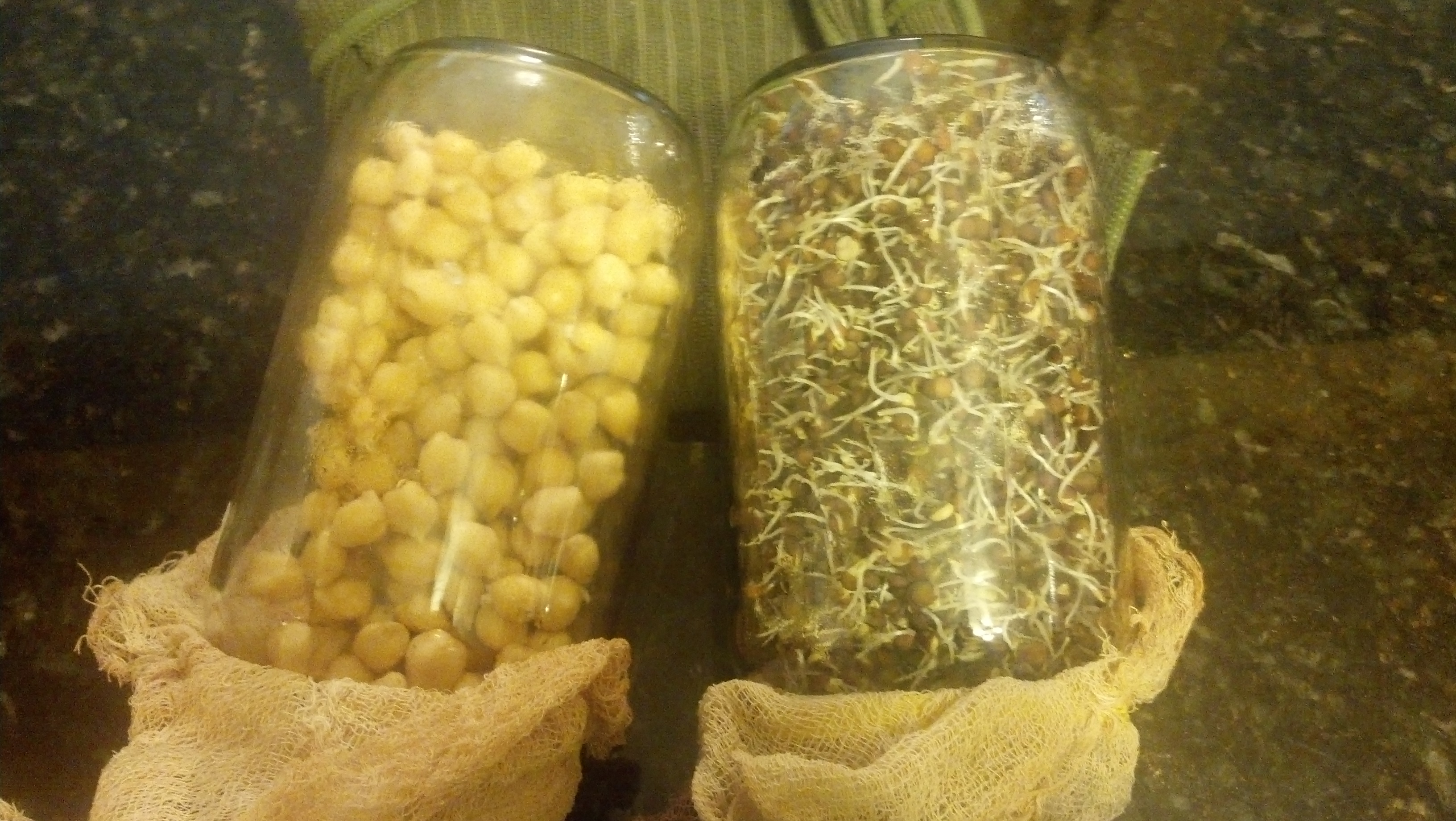
    Soaking lentils and chickpeas overnight,

    Soaking lentils and chickpeas overnight.

  3. Place jar in a horizontal position on your counter. It’s best to prop up the bottom of the jar with a folded towel to encourage excess water to drip out.
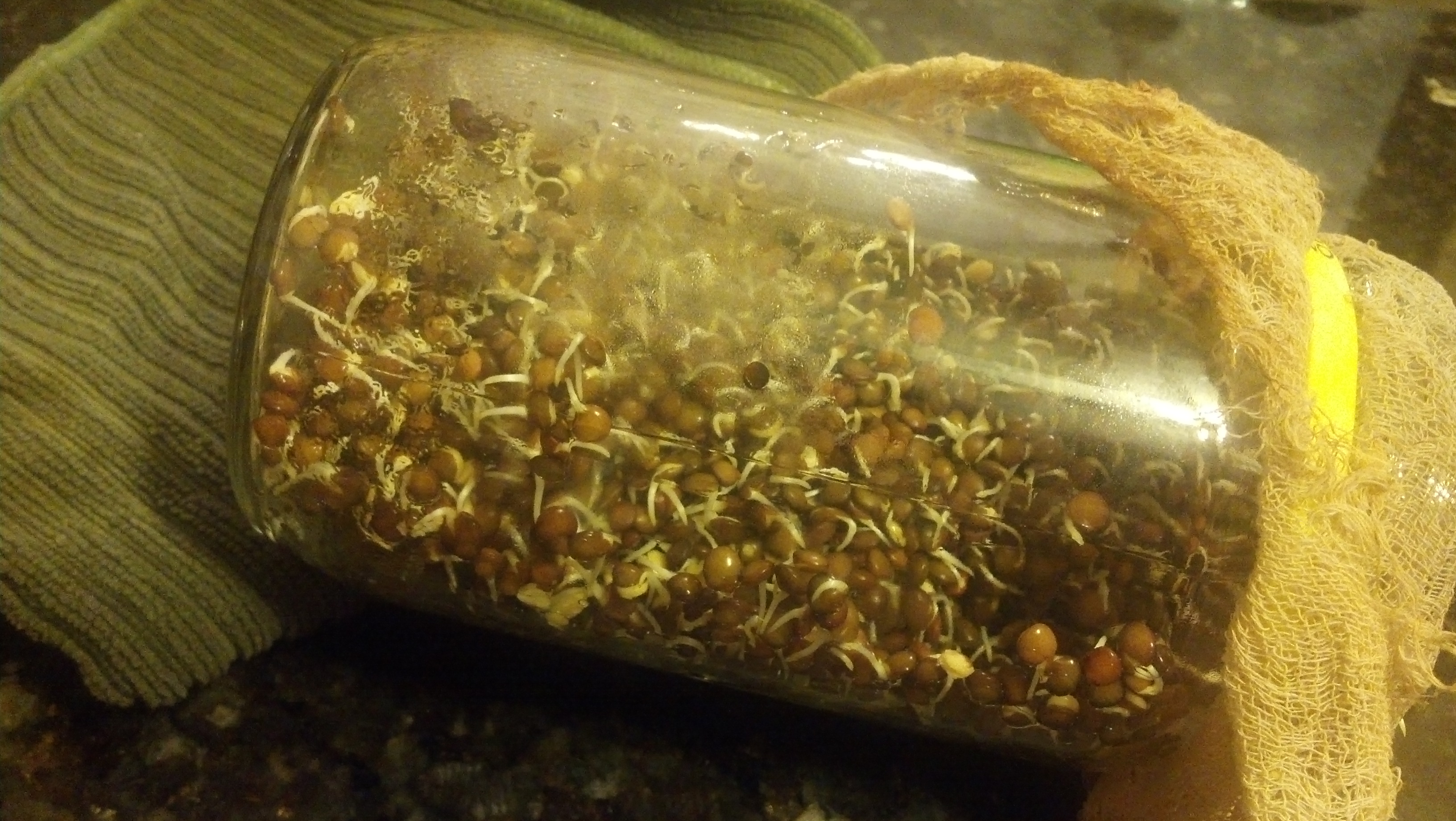
    Day one, lentils and chickpeas: propping jars up with towel.

    Day one: lentils and chickpeas; jars propped up with towel.

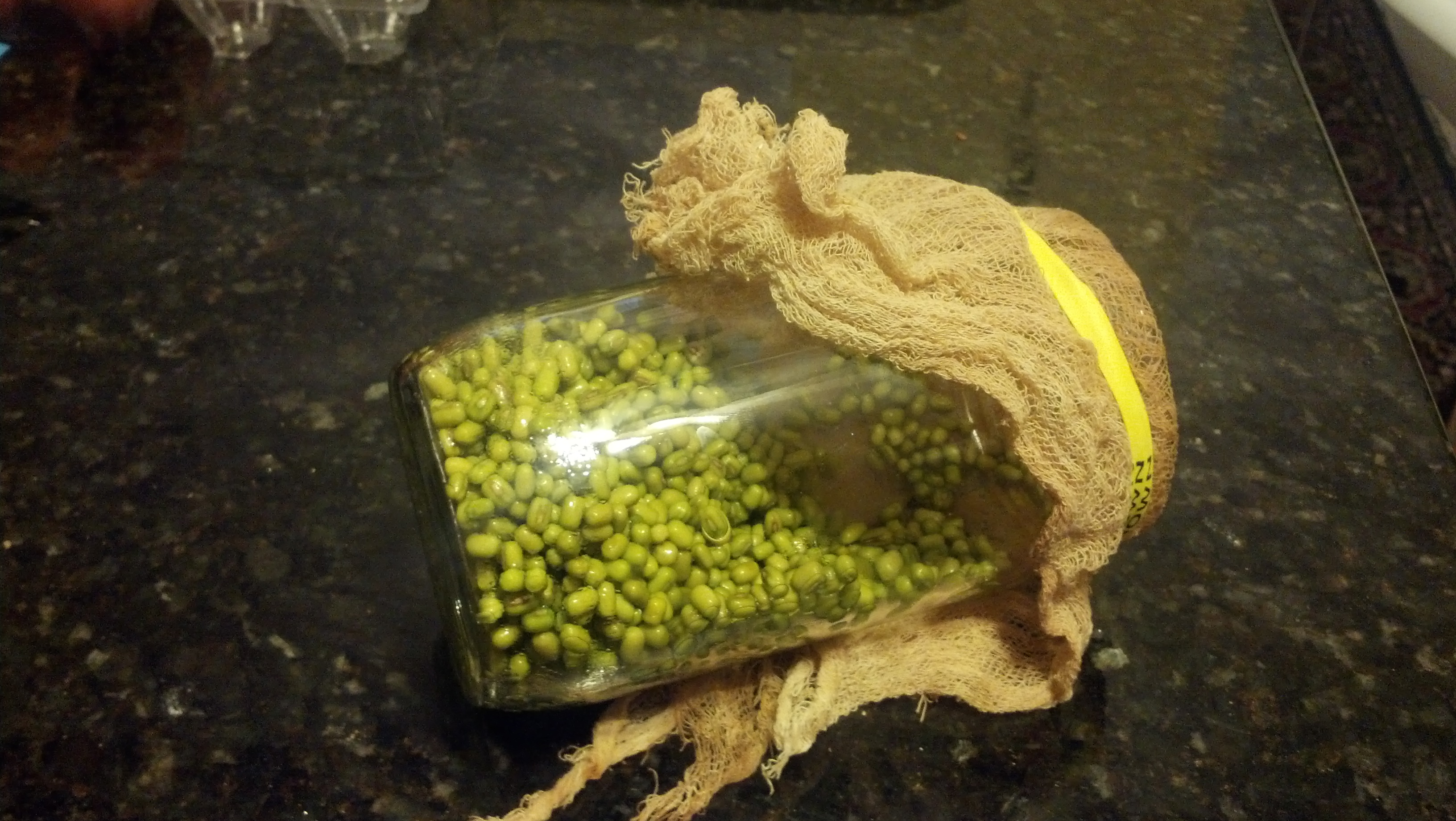
    Day one: mung beans

    Day one: mung beans

  4. Continue rinsing and draining the beans 3 to 4 times a day. Don’t worry if you have to go to work or go to sleep, they will be ok. Just rinse at least 2 times a day when you get a chance (am and pm).
  5. After a day or so, you will see your first sprouts! You can eat the bean once the sprout is a mere ¼ inch thick. But, the more you let it grow, the more nutrients you will get. Let the sprout grow until desired length, for a few days. (I like my mung bean sprouts to be about ½-¾ of an inch.). Optional: when the sprout is close to the desired length, some people place the jar near a window for half a day to “green” their sprouts (i.e. stimulate chlorophyll production). Keep rinsing during this process.

    Lentils: end of second day. I will let them continue to sprout for another half day or so.

    Lentils: end of second day. I will let them continue to sprout for another half day or so.

  6. Store sprouts in the refrigerator (you can keep them in the same jar). This will stop the sprouting process as well as the rotting process. Try to eat them within a few days, no more than five.
Day 2.4: Lentils are ready to go into the fridge! Chickpeas will stay out for another day or so. Most of them have grown little nubby tails and some have actually sprouted, so I will let them go a little longer (sorry it's hard to see in the photo).

Day 2.5: Lentils are ready to go into the fridge! Chickpeas will stay out for another day or so. Most of them have grown little nubby tails and some have actually sprouted, so I will let them go a little longer (it’s hard to see in the photo).

Day 2.5: Mung bean sprouts ready to eat!

Day 2.5: Mung bean sprouts ready to eat!

That’s it! You can enjoy sprouts in many different ways. I will discuss ideas in my next blog post and share some more tips about sprouting. In the meantime, sprouts can be enjoyed as is: pop them in your mouth like nuts—kids will love them too! Try sprinkling them on your salad. Make a raw paté or chumus.

More on all of this next time. 🙂

Happy Sprouting!


[1] Shipard 2005.

[2] Chavan and Kadam 1989.

[3] Ramesh et al 2011.

[4] Shipard 2005.

[5] Schwartz et al, 2010, 2011.

[6] Kurtzer and Xu 1997.


8 Comments

Almond milk made by YOU!

This recipe produced two 24-oz jars of almond milk, plus about 2 cups of pulp, on the right.

This recipe produces about two 24-oz jars of almond milk, plus about 2 cups of pulp.

We go through a LOT of almond milk in my house. Every time I shop I find myself picking up a few containers. My daughter loves drinking it in a glass, as does my husband, and we all enjoy it with our cereal.

But, I always feel a pit in my stomach whenever I glance at the side of the box. Preservatives, additives, who knows, even in the organic kind. So I decided, I’d make it myself!

The good news is that it is INCREDIBLY easy to make at home! I buy (A LOT of) organic, raw almonds from Wholefoods in the bulk aisle, which I keep in a gallon Ziploc bag. I’m in the process of looking for a cheaper bulk option, so I’ll keep you posted.

Equipment:

Glass jar or other container with cover

Blender (Vitamix is perfect, or another powerful blender)

Cheese cloth bag (like this one) or a fine mesh strainer

Large Bowl

Ingredients:

Two cups almonds

5 to 6 cups water

Vanilla extract (optional)

Sweetener, such as agave, coconut nectar (my choice), maple syrup, or honey (optional)

Preparation:

  1. Soak almonds 8-12 hours. (I usually put them to soak before bedtime or in the morning to make in the evening). To do this, simply put them in a glass jar or other container, fill with water, cover, and place in the fridge.
  2. After soaking is completed, rinse almonds in cold water.
  3. Place almonds and 5 cups water into blender. (If you have a small blender, you may have to do this in batches.)
  4. Add 1 Tbs sweetener of choice. (You may add another Tbs if you prefer added sweetness.)
  5. Add 1 Tsp vanilla extract (optional).
  6. Blend on high for 30-60 seconds, or until liquid gets creamy white. You will see pieces of almond pulp floating around.
  7. Use spoon to skim off some milk from the top to taste. Add more water (up to an additional cup), vanilla and/or sweetener to taste. Blend for 10 seconds.
  8. Please cheese cloth or strainer over large bowl. Poor almond milk into cheese cloth bag and squeeze out the milk; or poor into sieve and wait for the liquid to drip through. The pulp will be caught in the bag or sieve. Discard pulp or save for use in other recipe.
  9. Transfer the almond milk (and pulp, if you are saving it) to glass jars and refrigerate. Pulp can also be frozen for later use. Almond milk can last up to about 5 days; pulp will last a few days.

That’s it. It is so good, right? And I just love the creamy white color! After making your own milk a couple of times, you will figure out exactly how much water and sweetener you like. Making it will become like second nature to you. If you don’t drink a lot of almond milk, feel free to halve the recipe.

Stay tuned for a future post on what to do with the leftover almond pulp!

Enjoy!